Some links may help support Sugar Berry Home & Garden. Thanks for being here! ⓘ
A dining table can be one of the hardest pieces of furniture to fit into a small apartment.
You need enough room to actually eat, but you probably don’t want a table taking over the entire room when you’re not using it.
That’s why the best small-space dining tables aren’t simply smaller.
They change.
Some fold against the wall. Some collapse into narrow consoles. Others expand when guests arrive or provide hidden storage when you’re eating alone.
The goal is simple: get a useful dining area without sacrificing the rest of your room.
Which Type Is Right for You?
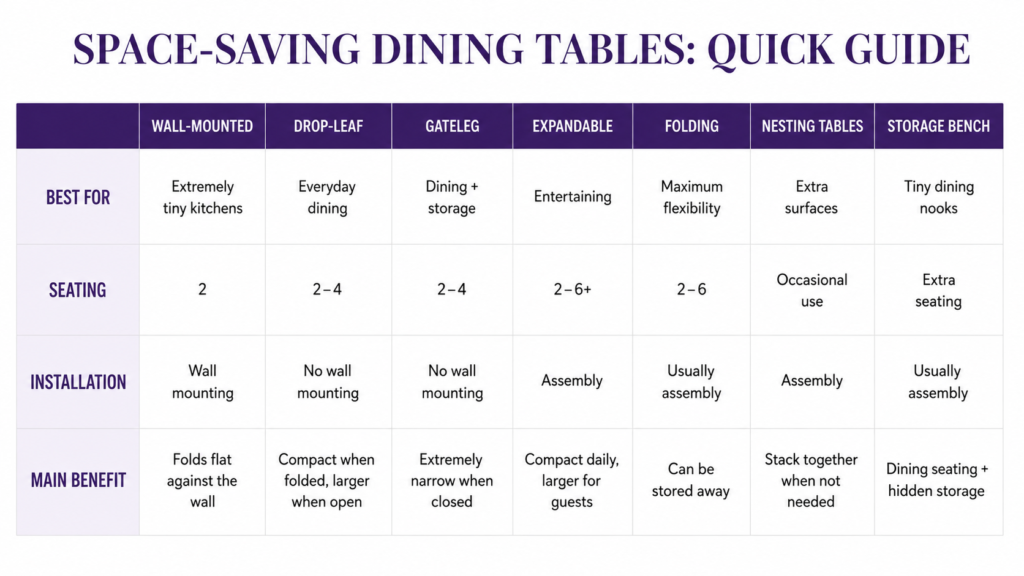
The most important thing isn’t choosing the smallest table.
It’s choosing the transformation that solves your particular space problem.
Best for Two People: Wall-Mounted Tables
If your kitchen is so small that even a tiny table makes the walkway uncomfortable, start with a wall-mounted design.
The tabletop folds down when you need it and folds flat against the wall afterward.
SHOP THIS SOLUTION
Best for: Tiny kitchens, studios and very small dining areas.
Seating: 2
Storage: Yes
Installation: Requires secure wall attachment.
The catch: This isn’t the best choice if you can’t drill into your wall or your lease restricts permanent installation.
Best for Everyday Dining: Drop-Leaf Tables
A drop-leaf table is one of the easiest ways to make a normal dining table work in a small room.
Keep the leaf down when you need a smaller footprint. Open it when you need additional seating.
SHOP THIS SOLUTION
Best for: Couples or small families who eat at the table regularly.
Seating: 2–4
Storage: No built-in storage.
Installation: No wall mounting.
Why choose it: You get a real dining table without committing the entire room to a large tabletop.
Best for Dining + Storage: Gateleg Tables
Gateleg tables take the space-saving idea one step further.
Instead of simply dropping a leaf, the table can become dramatically narrower when you don’t need it.
This is especially useful when the dining area has to share space with a living room or walkway.
SHOP THIS SOLUTION
Best for: Apartments where storage is almost as important as dining space.
Seating: 2–4
Storage: Yes.
Installation: No wall mounting.
Why choose it: It combines a surprisingly compact footprint with useful built-in storage.
Best for Entertaining: Expandable Tables
If your everyday dining situation is two people but you occasionally host friends, an expandable table can give you the best of both worlds.
Keep it compact most of the time and expand it when you need more seats.
SHOP THIS SOLUTION
Extendable Dining Table
Designed for smaller spaces and expands from a compact everyday configuration to a larger dining surface.
Best for: Small apartments where entertaining is occasional but important.
Seating: 2–6
Storage: Yes
Installation: Assembly required.
Before buying: Measure the fully extended dimensions—not just the compact size.
Best Folding Option: A Table That Can Almost Disappear
A folding table makes sense when you don’t need a permanent dining surface every day.
Some designs can fold down dramatically and be stored against a wall or in another narrow area.
SHOP THIS SOLUTION
Folding Dining Table with Storage
This folding design includes lower storage and can be configured for different uses. When fully opened, it can accommodate several diners; when folded, it takes up much less space.
Best for: Budget-conscious apartment dwellers who need maximum flexibility.
Seating: Up to approximately 4–6 depending on configuration.
Storage: Yes.
Installation: Assembly required.
Why choose it: It can function as more than just a dining table, making the footprint more useful.
Best for a Console-to-Dining Transformation
If your dining area doubles as an entryway or living space, a console-to-dining table can be especially clever.
Closed, it can sit against a wall with a very small footprint.
When guests arrive, it expands into a proper dining table.
SHOP THIS SOLUTION
Expandable Console Dining Table
Wayfair offers several expandable console designs that transform from narrow consoles into dining tables.
Browse expandable console dining tables →
Best for: Open-plan apartments and multipurpose rooms.
Seating: Varies by model.
Storage: Varies.
Installation: Usually assembly rather than wall installation.
Watch carefully: Some expandable consoles become surprisingly large when fully opened. Always check both sets of dimensions.
Best for Occasional Extra Surfaces: Nesting Tables
Nesting tables aren’t a replacement for a dining table, but they’re useful when your biggest problem is needing extra surface space occasionally.
They stack together when you don’t need them and separate when guests arrive.
SHOP THIS SOLUTION
The two tables nest together when not needed and separate when you want additional surfaces.
Best for: Small living rooms and occasional entertaining.
Seating: Not intended as a standard dining table.
Storage: No.
Installation: Assembly required.
Important: Think of these as flexible occasional tables, not a replacement for a dining-height table.
A Bonus: Add Storage Under the Dining Seat
Sometimes the table isn’t the only thing creating a space problem.
If you have a small dining nook against a wall, a storage bench can give you seating and hidden storage without adding another piece of furniture.
SHOP THIS SOLUTION
Lift-Top Dining Storage Bench
Look for a dining room or entryway bench with a comfortable seat and lift-up storage underneath.
Browse lift-top dining storage bench
Best for: Tiny dining nooks.
Storage: Hidden interior storage.
Installation: Usually assembly only.
Store: Table linens, placemats, napkins and other dining supplies.
How Much Table Do You Actually Need?
Don’t automatically buy the largest table that fits.
Think about how you actually use your dining area.
If you usually eat alone or as a couple
A small two-person table may be all you need.
A wall-mounted or compact drop-leaf table can keep the room open.
If you regularly eat with four people
Look for a table that comfortably accommodates four without requiring its largest configuration every day.
A drop-leaf or gateleg design can work particularly well.
If you usually eat with two but entertain occasionally
This is where an extending or expandable table makes the most sense.
Keep it compact during the week and expand it when guests arrive.
If you almost never use a dining table
Don’t force yourself to dedicate permanent floor space to one.
A folding table or wall-mounted option may make more sense.
Don’t Forget the Chairs
A common small-space mistake is measuring only the tabletop.
The chairs need space too.
Before buying, measure:
- The table’s closed dimensions
- The table’s fully expanded dimensions
- Table height
- Chair width
- Space needed to pull chairs out
- Walking space behind the chairs
- Door and cabinet clearance
- Where extra chairs will be stored
If the table fits but nobody can comfortably pull out a chair, it doesn’t really fit.
What Works Best for Renters?
If you’re renting, focus on freestanding transformations unless your landlord allows wall installation.
Usually renter-friendly:
- Drop-leaf tables
- Gateleg tables
- Folding tables
- Expandable tables
- Nesting tables
Requires more planning:
- Wall-mounted tables
A wall-mounted table can be brilliant in a tiny kitchen, but it needs secure attachment to the wall. The correct fasteners depend on the wall material.
If drilling isn’t practical, choose a freestanding table that can shrink instead.
The Tiny Dining Table Buying Checklist
Before clicking Buy, ask:
☐ How many people actually need to sit here every day?
☐ How many people do I occasionally need to accommodate?
☐ What are the closed dimensions?
☐ What are the fully expanded dimensions?
☐ Can people comfortably pull out the chairs?
☐ Where will extra leaves or chairs go?
☐ Does it require wall installation?
☐ How much assembly is required?
☐ Does it provide storage?
☐ Does it still leave the room usable when expanded?
That last question is the one people often forget.
The Best Table Is the One That Gives Your Room Back
A small apartment doesn’t mean you have to give up having a real dining area.
You just need furniture that understands the space has more than one job.
A wall-mounted table can disappear after breakfast.
A drop-leaf can stay compact until dinner.
A gateleg can provide both dining space and storage.
An expandable table can make room for friends without taking over the apartment all week.
And a folding table can be put away when you simply don’t need it.
The goal isn’t to find the smallest dining table.
It’s to find the table that gives you the most usefulness for the amount of space it occupies.
That’s what makes space-saving furniture worth buying.