Some links may help support Sugar Berry Home & Garden. Thanks for being here! ⓘ
A small room doesn’t need less personality. It needs smarter places for personality to live.
When floor space is limited, the best design changes are the ones that work vertically, visually, or without adding bulky furniture. A bold wall can transform a room without taking up floor space. Floating shelves can add storage without stealing walking room. New hardware can modernize a kitchen without replacing the cabinets.
The trick is knowing which change solves which problem—and knowing when to stop.
Here are eight small-space design ideas that can add storage, privacy, warmth, personality and function without making your home feel overloaded.
Need More Personality? Make One Wall the Star
A tiny living room doesn’t automatically need white walls everywhere.
One bold accent wall can give the room a focal point while leaving the rest of the space light and open.
Deep blueberry, rich violet, dark green or another saturated color can work beautifully when the surrounding furniture and walls are lighter.
Good candidates include:
- The wall behind the sofa
- The wall behind the bed
- The wall behind a desk
- A fireplace wall
- A wall that naturally catches your eye
SHOP THIS SOLUTION
BEHR PREMIUM PLUS Mountain Blueberry Interior Paint — Home Depot
For a colorful Sugar Berry Home & Garden look, BEHR PREMIUM PLUS Mountain Blueberry is a deep blue-purple option that pairs especially well with cream, warm white and light wood.
Keep the surrounding walls lighter and avoid surrounding the accent wall with lots of dark furniture.
The result is one strong design moment instead of several competing ones.
Want the Room to Feel More Open? Start With Soft Neutrals
Instead of making one wall dramatic, you can also create a light, warm foundation.
Think:
- Warm white
- Cream
- Soft beige
- Light oak
- Warm gray-beige
- White textiles
The key is warmth.
A completely stark white room can feel cold, while a warm neutral palette creates softness without adding visual weight.
SHOP THIS SOLUTION
BEHR PREMIUM PLUS Swiss Coffee Interior Paint & Primer — Home Depot
Swiss Coffee is a warm neutral option that works well as a backdrop for light wood, colorful accents and natural textures. The current Home Depot listing identifies it as an interior paint and primer with a flat finish.
Use the neutral palette as your foundation, then introduce personality through one or two stronger accents.
Need More Storage? Use the Walls
When you don’t have much floor space, your walls become valuable real estate.
Floating shelves add storage and display space without introducing another cabinet or bookcase.
For a small room, don’t treat a shelf like a storage locker.
Try styling it with:
- A few books
- One framed print
- One small plant
- One decorative object
Then stop.
Empty space is part of the design.
Before installing any shelf, check your wall type and use fixing devices appropriate for that wall.
SHOP THIS SOLUTION
These wall shelves are a simple option for displaying a few useful or decorative pieces.
Need Visual Warmth Without Adding Furniture? Add Wood
Pin 24 is about using warm wood to soften a modern small space.
You don’t need a wooden coffee table, cabinet and dining set all at once.
A smaller wood accent can do the job.
Use it on a coffee table, ottoman, console or kitchen counter to corral a few everyday items.
The goal is warm and coordinated, not rustic or cluttered.
SHOP THIS SOLUTION
The tray is a useful way to introduce natural wood without taking over a small surface.
Need a Modern Update Without Renovating? Change the Hardware
One of the easiest ways to change the personality of a kitchen or bathroom is also one of the smallest.
Cabinet hardware.
Matte black pulls create crisp contrast against cream, white, light wood and neutral cabinetry without requiring new cabinets.
Before ordering, measure the distance between the centers of the existing screw holes.
That measurement matters more than the overall length of the handle.
If you’re renting, keep the original hardware so you can put it back when you move.
SHOP THIS SOLUTION
Need Privacy? Create a Zone With a Room Divider
Small homes often have to do several jobs at once.
Your living room might also be your office.
Your bedroom might share space with a dressing area.
Your dining area might double as a workspace.
A freestanding room divider can create a visual boundary without building another wall.
For a small room, don’t automatically buy the widest screen available.
Measure the area you want to define first.
The divider should create a zone without blocking your main walkway.
SHOP THIS SOLUTION
The Folding Room Divider gives you a way to visually separate an area while keeping the change reversible.
Need to Separate Rooms Without Losing Floor Clearance? Try a Sliding Door
A traditional hinged door needs clearance every time you open it.
In a small bathroom, bedroom, pantry or laundry area, that swing can interfere with furniture or walking space.
A sliding door moves along the wall instead.
This is one of the more permanent ideas in the article, so it’s better suited to homeowners or renters with permission to make the installation.
Measure before buying.
You need enough wall space beside the doorway for the door to slide, plus adequate clearance above the opening for the track.
SHOP THIS SOLUTION
The Masonite 36 in. x 84 in. 3-Lite Frosted Glass Sliding Barn Door is one option when you want separation and privacy without a traditional door swing.
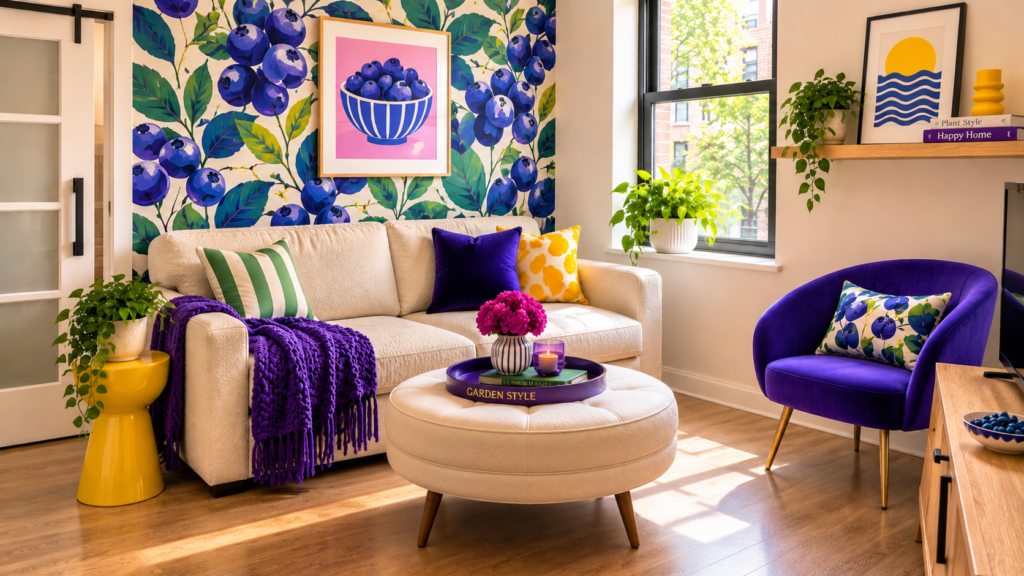
Want Personality Without Decorating Every Surface? Use Peel-and-Stick Wallpaper
Pin 114 is another way to create a strong visual change without adding furniture or taking up floor space.
But you don’t need to wallpaper the entire room.
One wall is usually enough.
Use it behind:
- A sofa
- A bed
- A small desk
- An entryway console
- A reading nook
Because peel-and-stick wallpaper can behave differently depending on the wall surface, preparation matters. Follow the manufacturer’s instructions and test a small area first.
For a small space, follow one important rule:
Wallpaper one wall. Leave the others quiet.
That lets the pattern provide personality without surrounding you with pattern.
SHOP THIS SOLUTION
Floral Peel-and-Stick Wallpaper
The Floral Peel-and-Stick Wallpaper is a blue patterned option with a removable, peelable finish.
How to Choose the Right Idea for Your Room
You don’t need to use all eight ideas in one room.
Choose the solution based on the problem you’re actually trying to solve:
Need more storage?
Start with floating shelves.
Need privacy?
Try a room divider.
Need a modern update?
Change the hardware.
Need to separate rooms?
Consider a sliding door.
Need personality?
Use an accent wall or wallpaper.
Need warmth?
Add a small wood accent.
Need the room to feel lighter?
Build your foundation around warm neutrals.
This makes the process easier: solve the problem first, then decorate around the solution.
Renter-Friendly Ideas
If you’re renting, focus on changes that can move with you.
Good options include:
- Peel-and-stick wallpaper, with lease approval
- Freestanding room dividers
- Decorative wood accents
- Replaceable hardware where permitted
- Textiles
- Lamps and lighting
- Rearranging existing furniture
Floating shelves and sliding doors are more installation-heavy, so they require permission and proper mounting.
And remember: “removable” doesn’t automatically mean appropriate for every wall. Check your lease and the manufacturer’s instructions before making changes.
Low-Cost Changes With the Biggest Visual Impact
You don’t have to replace your biggest piece of furniture to make a small room feel different.
Start with the details that change the room’s visual language.
Paint
One wall can completely change the room.
Hardware
A handful of cabinet pulls can make an entire kitchen feel more current.
Wood accents
A small wood piece can add warmth without taking up meaningful floor space.
Floating shelves
One shelf can add both display space and useful storage.
Wallpaper
A single feature wall can create a dramatic focal point.
The goal isn’t to spend more.
It’s to make the changes you do make work harder.
Small-Space Design Tricks That Make the Room Feel Better
Keep the floor visible
Visible floor makes furniture feel less crowded.
Use vertical space
Walls can carry storage, art and personality.
Keep large surfaces calm
A bold wall works better when the sofa, curtains and surrounding walls aren’t competing with it.
Repeat colors
If you use blueberry blue once, repeat a small amount of it somewhere else.
Repeat materials
Light wood looks more intentional when it appears in several small places.
Create one focal point
Give the eye somewhere to land.
Leave empty space
Empty space isn’t wasted space. It’s what allows the things you love to stand out.
Mistakes to Avoid
Making every wall a feature wall.
One strong wall usually has more impact than several.
Buying furniture before measuring.
Measure the room, doorway and walking paths first.
Filling every shelf.
Storage and display need breathing room.
Mixing too many wood finishes.
Choose one dominant wood tone and repeat it.
Using too many accent colors.
Pick a small palette and repeat it.
Ignoring door clearance.
A beautiful door isn’t helpful if it blocks your only walkway.
Forgetting renter restrictions.
Check your lease before painting, drilling or installing hardware.
Adding more instead of editing.
Sometimes the best small-space improvement is removing one unnecessary thing.
The Small-Space Design Formula
If you’re staring at your room wondering where to start, keep it simple:
Light foundation + one statement + one warm material + one useful vertical solution + clear floor.
For example:
- Warm cream walls
- One blueberry accent wall
- Light wood accents
- One floating shelf
- Matte black hardware
- Minimal floor furniture
Or:
- Soft neutral walls
- One blue patterned wallpaper wall
- Light wood
- A freestanding room divider
- Minimal decoration
Both approaches can feel completely different while following the same principle:
Don’t use more space to create more style. Use better design.
Final Thought
The best small-space design ideas don’t make a home feel like a smaller version of a large house.
They make the space feel purposeful.
A floating shelf uses the wall.
A room divider creates a zone.
A sliding door eliminates a door swing.
Hardware changes the look without adding bulk.
Wood adds warmth.
Paint adds personality.
Wallpaper creates a focal point.
And none of those ideas require filling the room with more furniture.
You don’t need more room to make your home beautiful.
You need to decide what deserves the space you already have.
Fewer things. Better things.