Some links may help support Sugar Berry Home & Garden. Thanks for being here! ⓘ
In a studio, the bed is part of the living room. Guests sit ten feet from your pillows, and you work from the sofa while staring at laundry. A curtain helps a little, but it looks temporary and blocks the light.
The direct answer: use a freestanding divider that’s open or translucent, not solid. An open-shelf divider separates the bed from the living area, adds storage, and still lets light through. If you need to move it or hide more, a folding screen is the lightweight alternative. No drilling for either. A room divider with storage does both jobs: it creates privacy and holds your things.
Tribesigns 71" Room Divider With Shelves

Best for: studios that need a clear bedroom zone plus extra storage, without blocking light.
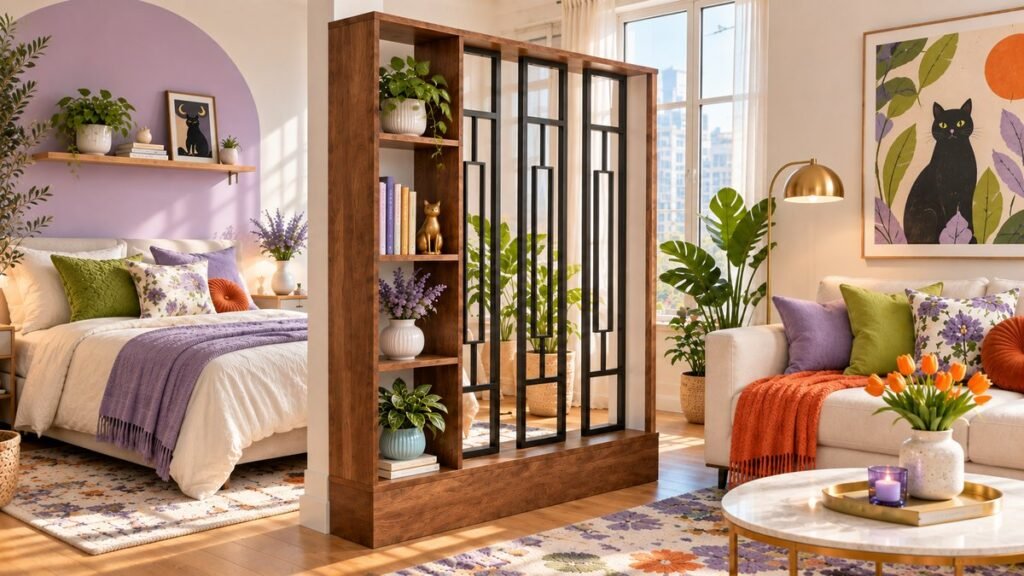
At 47.2″ wide, 11.8″ deep and 70.9″ tall, it separates the bed from the living area and gives you open shelves for books and plants. Vertical metal bars let light and air through. A thick 6.5″ base and an anti-tip device keep it steady.
Need to fold it away when guests leave, or roll it around the room? The Amsleekey louvered screen is on lockable wheels and splits into two low screens.
The Best Room Dividers for a Studio Apartment

Open shelves and metal bars, 71″ tall, with an anti-tip device.
See the details ↓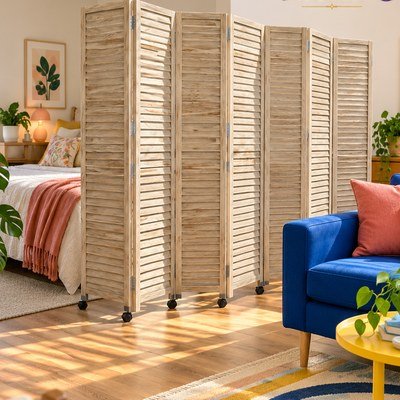
95″ louvered wood screen on lockable wheels that splits in two.
See the details ↓
Shoji-style white panels in a wood frame that fold flat.
See the details ↓How to Divide a Studio Without Making It Feel Smaller
The secret is partial separation. A divider that stops short of the ceiling and lets light through defines a zone without cutting the room in half. On an 8-ft ceiling, a 67″–71″ divider leaves about 2 feet of open space above, so light and air still flow.
We compared these by height, how much light passes, footprint, stability and whether they add storage. All three are freestanding, so there’s no drilling.
We haven’t used these ourselves. Our notes come from listed dimensions and features. The Sugar Berry Score is our own small-space rating, not Amazon’s star rating.
- Walkway: keep about 30″–36″ of path around the divider.
- Light: put the divider at a right angle to the window, not in front of it.
- Stability: load heavy things on low shelves, and keep folding screens in a zigzag.
What to Look For in a Studio Room Divider
The right divider makes a studio feel like two rooms. The wrong one feels like a wall in the middle of your home.
- Height: around 66″–71″ blocks the view while seated or standing and leaves light above.
- Open, slatted or translucent: light should pass through. Solid panels make studios feel smaller.
- Stability: wide bases, anti-tip devices and zigzag folds keep dividers upright.
- Footprint: shelf dividers take about 12″ of depth. Folding screens need more in a zigzag.
- Storage: a shelf divider replaces a bookcase, so it can save floor space elsewhere.
- No drilling: all three picks here are freestanding and renter-friendly.
A Bookshelf Room Divider With Storage
A shelf divider does two jobs in one footprint. It defines the bedroom and holds the books, plants and baskets that would otherwise need another piece of furniture.
Best for privacy plus storage: Tribesigns 71″ Room Divider With Shelves
Sugar Berry Score: ★★★★½ 4.5/5As a bookshelf room divider, it’s the best room divider with storage here, and the easiest studio bedroom divider to style.
- Size: 47.2″ W × 11.8″ D × 70.9″ H
- Storage: open shelves (coat hooks listed as a feature)
- Build: MDF shelves, thickened metal tubing, 6.5″ base
- Safety: anti-tip device included
- Design: vertical metal bars. Light and air pass through.
👍 Pros
- Adds storage while it divides
- Lets light through, so the room stays bright
- Only 11.8″ deep
- No drilling needed
👎 Cons
- Styled shelves need editing to look calm
- 47″ wide may not screen a whole queen bed
- Heavy items up high can make it top-heavy
Stand it at the foot or side of the bed, at a right angle to the window. At 47″ wide, it screens the bed from the sofa’s view without blocking the path.
Style it with books, one plant and a basket, and leave some gaps. A packed divider looks like a wall of clutter.
Not for: very narrow studios where an 11.8″-deep unit would block the only walkway.
A Folding Room Divider or Freestanding Screen You Can Move
Folding screens are lightweight and flexible. Open them when you need privacy, and fold them away when you don’t.
Best for moving it around: Amsleekey 6-Panel Louvered Wood Divider
Sugar Berry Score: ★★★★ 4.4/5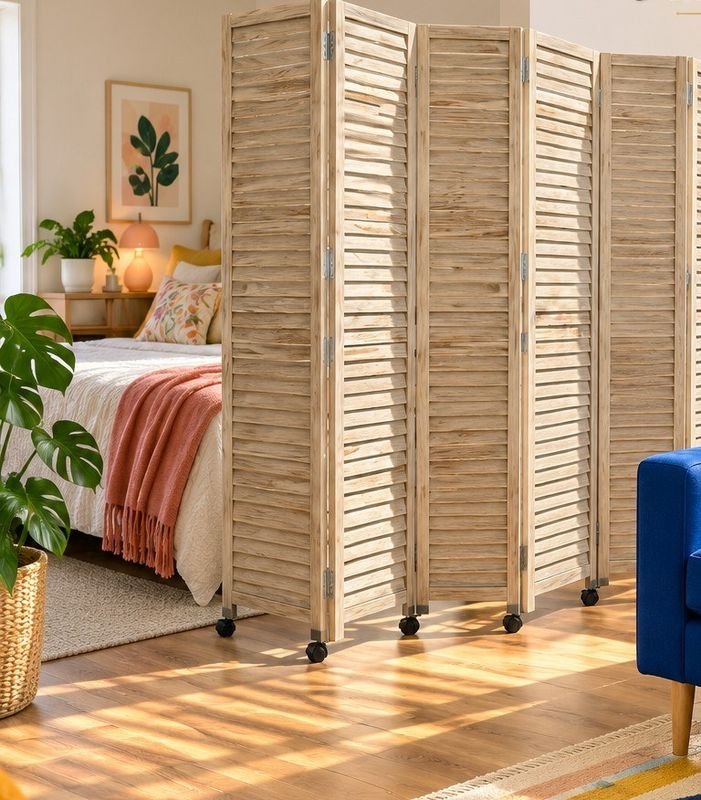
It’s a slatted wood room divider and a freestanding room divider in one, so it’s the classic room divider with no drilling.
- Size: 95.3″ W × 67″ H (flat), 6 panels
- Split: detaches into two low screens, 32.3″ tall
- Wheels: lockable casters
- Material: paulownia wood, 0.7″ frame, stainless hinges. Paint-free torched finish.
- Folded: 4.7″ thick. Tool-free setup with pins and an Allen key.
👍 Pros
- Rolls anywhere and locks in place
- Splits into two low screens, like a desk divider or pet gate
- Folds to 4.7″, so it slides under a bed
- Louvers let air and some light through
👎 Cons
- The rustic wood look suits some rooms more than others
- Semi-private, since the louvers have gaps
- Takes floor space in a zigzag
The wheels are the small-space win. Roll it in front of the bed when friends come over and roll it away after.
Set up in a gentle zigzag, it takes less than 8 ft of width. Straight across, it needs the full 95″.
Not for: anyone who needs complete visual privacy.
Best for soft, light-filled privacy: ALeesing 6-Panel Shoji Folding Screen
Sugar Berry Score: ★★★★ 4.3/5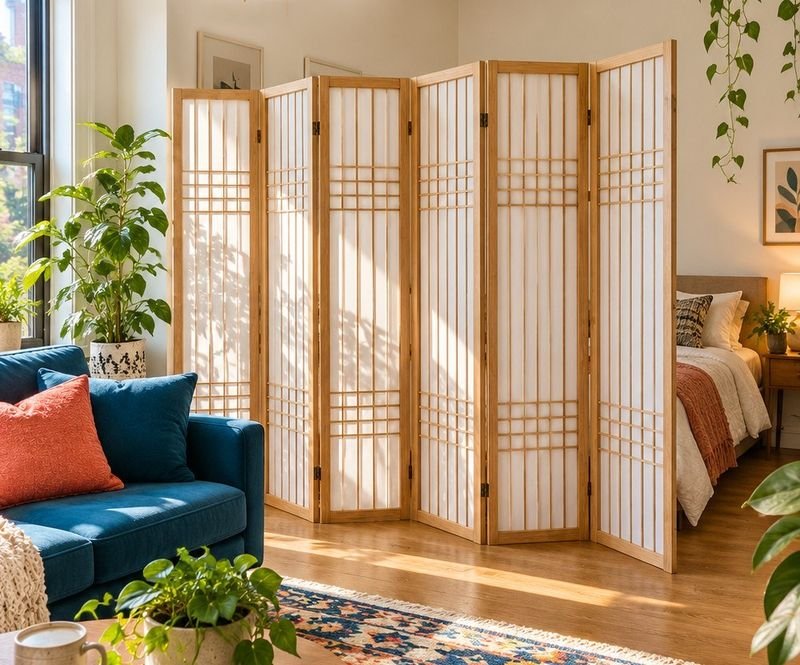
This folding room divider is the best privacy screen for a studio apartment if you want light, not shadow.
- Size: 94.5″ W × 66.9″ H (flat), 6 panels
- Panels: white shoji-style, light passes through
- Frame: light brown wood, lattice top and grid bottom
- Setup: stand in a W or Z shape. Folds flat.
👍 Pros
- Glows with light but blocks the view
- Lightweight and easy to move
- Clean Japanese lattice design
- Folds flat to store
👎 Cons
- No wheels
- Shoji-style panels can tear
- Needs a zigzag to stand
This is the softest option. Light passes through, so a studio stays bright, and the white panels hide the view of the bed completely.
Use it as a dressing screen too.
Not for: homes with pets or kids who might poke through the panels.
Studio Apartment Room Divider Ideas: 4 Layouts That Work
Placement matters as much as the divider itself. These layouts work in most studios:
- At the foot of the bed: the classic. The bed becomes a separate “room” and the sofa faces away from it.
- Beside the bed, perpendicular to the wall: creates a nook in a long, narrow studio. Put the divider’s open side facing the window.
- Behind the sofa: a shelf divider behind a floating sofa adds a “wall” and holds lamps and books within reach.
- Around a desk: the Amsleekey’s low 32.3″ panels make a work zone without feeling closed in, and they’re great for video calls.
Add a rug to each zone to finish the separation. A rug under the bed area and another under the sofa makes two rooms out of one, even before the divider goes up.
Mistakes to Avoid With a Room Divider
These are the most common reasons this kind of purchase disappoints in a small home.
- Choosing a solid divider. It blocks light and makes a studio feel smaller.
- Putting it in front of the window. Place it at a right angle to the window instead.
- Overloading shelf dividers. Heavy books up high make them top-heavy.
- Standing folding screens flat. They need a zigzag to stay upright.
- Blocking the walkway. Keep 30″–36″ of clear path around the divider.
Room Dividers Compared
| Product | Width | Height | Light | Storage | Moves | Score |
|---|---|---|---|---|---|---|
| Tribesigns 71" Room Divider With Shelves | 47.2″ (11.8″ deep) | 70.9″ | Open bars | Shelves | Heavy | 4.5 |
| Amsleekey 6-Panel Louvered Wood Divider With Wheels | 95.3″ flat | 67″ (or 32.3″) | Louvered gaps | No | Wheels | 4.4 |
| ALeesing 6-Panel Shoji Folding Privacy Screen | 94.5″ flat | 66.9″ | Glows through | No | Light, folds | 4.3 |
Which Divider Should You Choose?
- If you want privacy and more storage, get the Tribesigns shelf divider.
- If you want to roll it around or split it, get the Amsleekey louvered screen.
- If you want soft light and a full visual screen, get the ALeesing shoji screen.
Who These Are Not For
A divider won’t fix these:
- Noise. None of these block sound.
- Needing a locking door. For that, you’d need a real wall or a larger apartment.
- Very narrow studios, where any divider blocks the walkway. Use a rug to define zones instead.
Frequently Asked Questions
How do you divide a studio apartment without curtains?
Use a freestanding shelf divider or a folding screen. They define zones, need no drilling and look like real furniture.
Will a room divider make my studio feel smaller?
Not if it’s open or translucent and shorter than the ceiling. Open shelves, louvers and shoji-style panels all let light through.
How do I stop a room divider from tipping?
Use the anti-tip device if one is included, keep heavy items on low shelves, and stand folding screens in a zigzag, not a straight line.
How tall should a room divider be?
Around 66″–71″ works in a room with an 8-ft ceiling. It blocks the view when you’re seated or standing and still leaves space above for light.
What is the best room divider for a studio apartment?
A bookshelf-style divider like the Tribesigns if you want storage too. Choose a folding screen if you want to move it often or fold it away.
The Bottom Line on Studio Room Dividers
Separate the room without sealing it off. For most studios, the Tribesigns shelf divider is the best mix of privacy, storage and light.
For more small-space layout ideas, read the curation rule for living in under 500 square feet.
See Tribesigns 71″ Room Divider With Shelves on Amazon →
Shop This Article
- Tribesigns 71" Room Divider With Shelves — best for privacy plus storage
- Amsleekey 6-Panel Louvered Wood Divider With Wheels — best for moving it around
- ALeesing 6-Panel Shoji Folding Privacy Screen — best for soft, light-filled privacy
Paid links. Check Amazon for current price, colors and availability.